· Marcus Reed
How to Carry a Bike Lock: Where It Rides and What Each Spot Costs
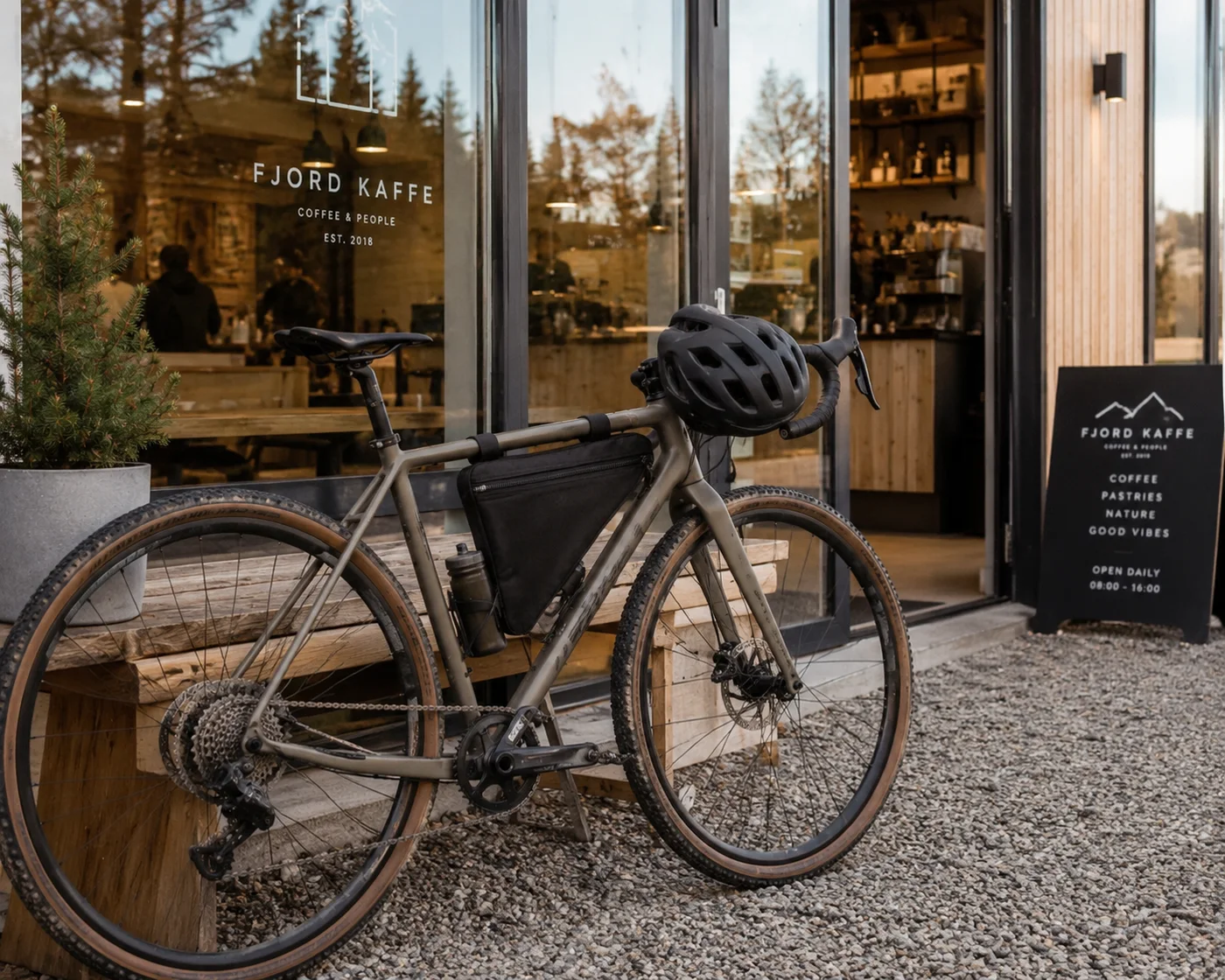
Every other item you carry gets packed once and forgotten. The lock does not. It is a solid, unyielding lump, it has a shape that fits nothing, and it has to be in your hand within seconds of stopping. Here is what each of the usual spots costs you, the placements I will not recommend at any price, and how to stop the lock being the one noisy thing on the bike.
The lock is the one thing you carry that has to come off
Look at the standard ride kit and every item shares a habit — it sits still. A tube, a set of levers, a pump and a multitool live in the same place for a season. That is why they are easy to solve: put them somewhere sensible, cinch it down, stop thinking about them. Our packing checklist is built around gear that behaves like that.
A lock breaks every part of the pattern. It is handled twice on every trip, so whatever holds it has to release as fast as you can work one-handed. It is dense and hard with no give anywhere, so the soft items around it cannot cushion it the way they cushion a tool. And its outline nests against nothing, which is why it ends up crammed rather than placed. A lock is not a packing question — it is a mounting question.
Where riders put it, and what each spot costs
This is the same question we answer for every bag on this site, so the logic will look familiar from our bag comparison. Weight low and between the wheels barely registers. Weight high, or out past an axle, changes how the bike leans and holds a line.
| Where it ends up | Where the weight sits | What it costs you |
|---|---|---|
| Held against a frame tube | Low, between the wheels, near the bike's balance point | Needs a proper mount and something soft against the paint; check clearance at full steering lock |
| Closed inside a bag on the bike | Wherever that bag sits — low in the triangle, or out at one end | Only works if the lock cannot shift inside — a hard object with room to move is what makes any load noisy |
| In a backpack | High, on your shoulders, above your center of gravity | Top-heavy in fast corners, a hot back, and the whole load comes off whenever you want anything |
| Around your waist or across your body | On you, moving when you move rather than with the bike | Shifts as you pedal and lean, and puts a hard object between you and the ground. Not our recommendation |
| On a rear rack or platform | Behind and above the rear axle, off the tail of the bike | Noticeable sway when you stand to climb; must be strapped so it cannot move toward the wheel |
Read down the middle column and you get the pattern this whole site is built on: the closer a load sits to the middle and the bottom of the bike, the less you feel it. The right-hand column is nearly all one thing — movement.
Four places a lock should never ride
Not against your cables or hoses. Brake and gear lines run along the frame, and a dense object pressed against them or rubbing across them is interfering with the parts that stop you and change gear. Our install guide spends a whole section on cable clearance for a soft bag — a lock deserves more caution, not less.
Not on the handlebars. The bars turn, and anything hung on them turns with them, swings on the way round, and adds weight exactly where you least want it: high, forward and inside the steering. It also puts hard material within reach of your brake levers.
Not where it can reach a wheel. Anything that can slip, sag or rotate toward the spokes or a brake disc is a problem waiting for the first pothole. That includes a lock loose on a rack platform, and a lock held low where the front wheel swings back at full steering lock — a clearance our small-frame guide covers, because it tightens as frames get shorter.
Not dangling from a strap or a loop. A lock hung by one point is a pendulum, and a pendulum with that much mass beats against whatever it can reach.
One test covers all four: fit it, then try to move it with your hand. If it turns, slides, tips or swings, it is not mounted, it is resting there.
Rattle: why a lock is louder than the rest of your kit
Noise on a bike is rarely about the object — it is about the gap. A multitool rattles in an empty bag and goes silent once a tube and a jacket sleeve fill the space around it. That is the principle behind the packing order we teach.
A lock cannot be handled that way, because it is bigger and harder than anything you would pad it with. So the fix is not cushioning, it is tension: whatever holds it has to be pulled tight enough that the lock and the bike become one object. That is what riders describe when a strap-mounted load is set up properly — one verified buyer put it about the Trail as "sits snug in the frame and doesn't rattle on rough ground."
Here is the test I run before a bike leaves: lift it a few inches by the saddle and let it drop back onto its tyres. One clean thump is right. A thump followed by a tap means something still has room to move. Repeat it after the first few miles, because straps and mounts settle under load.
What the weight does when you get out of the saddle
Seated, the bike is a stable platform and a dense object anywhere on it is just extra mass. Out of the saddle you swing the whole bike underneath you on every pedal stroke, and everything you carry swings with it — by how much depends on how far it sits from the pivot.
We measured this the boring way, carrying the same kit three ways on one loop — the run is written up on the Ridgeline Trail page and the method behind it on how we test. In the frame triangle: the bike leaned and braked normally, no sway on the descent. Behind and above the rear axle: noticeable sway standing to climb. On the rider's back: top-heavy in fast corners. A lock concentrates its mass in one solid piece, so it sharpens those differences rather than softening them.
The practical consequence is simple. If the lock rides on the bike, put it as close to the middle and as low as the bike allows, and make sure it cannot move there. If it has to ride at one end, expect to feel it when you stand.
Americans ride a bicycle each year
— Outdoor Industry Association, 2023
That is a lot of riders solving the same placement problem privately, and it gets tighter every year: on an e-bike, a battery in or on the down tube can already own the run of frame you were planning to use. Our guide to short and unusual frames covers how fast that space disappears.
Paint, rub and the marks you only find in spring
The frames that come back marked are never the ones where something was mounted tightly. They are the ones where a hard part sat against paint with road grit between them and enough movement to work it in.
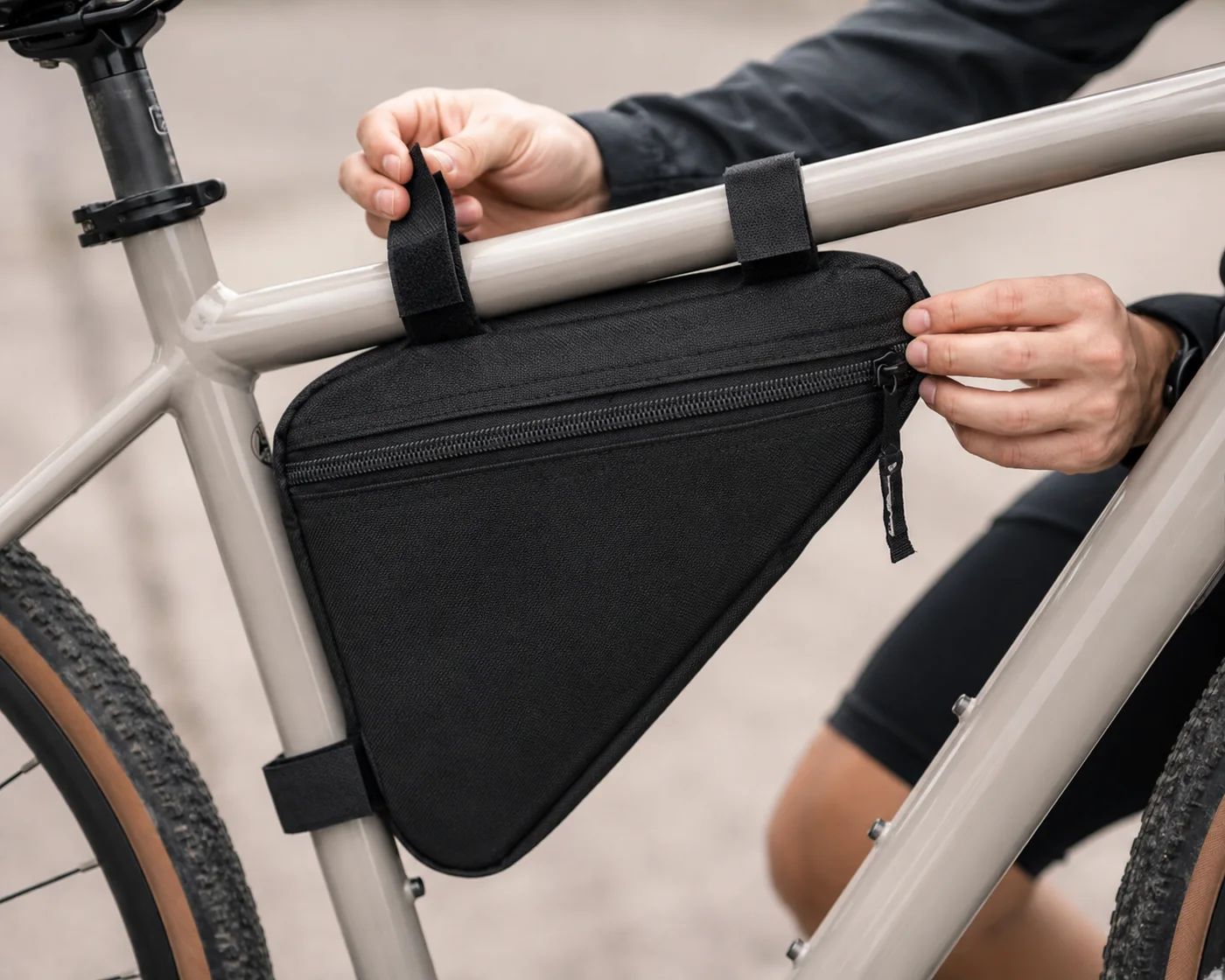
That is why every bag on this site holds on with wide hook-and-loop straps that wrap the tubes instead of clamping metal onto them. No hardware touches your paint at all, and the strap spreads its load over a broad, soft area. On carbon and premium finishes we go one step further and put a strip of protective tape or a piece of old inner tube under the straps. Those are the same two habits a lock needs.
Then keep the contact area clean. Grit collects exactly where you cannot see it, so a wipe under anything that touches the frame does more for your paint than a deep clean twice a year — the logic we set out in how to clean a frame bag.
The thirty seconds when you park
A mount that needs two hands is a mount you will stop using by the second week. Test it the way you will use it: stand the bike up, keep one hand on the bars, free the lock with the other. If that takes more than a few seconds, the placement is wrong however well it rides.
The other half of parking is what leaves with you, and it is easier if those things already live in something that lifts off. That is a deliberate design choice on the Ridgeline Roll: it runs on detachable straps and comes away on a shoulder strap in one movement when you lock the bike up.
Gear that stays with the bike is a different job: a repair kit is no use to you in a café. That is the split to plan for — valuables in something that detaches, tools and spares strapped in the frame, the lock handled at both ends of the trip.
Settle the rest of the kit, and the lock becomes one object
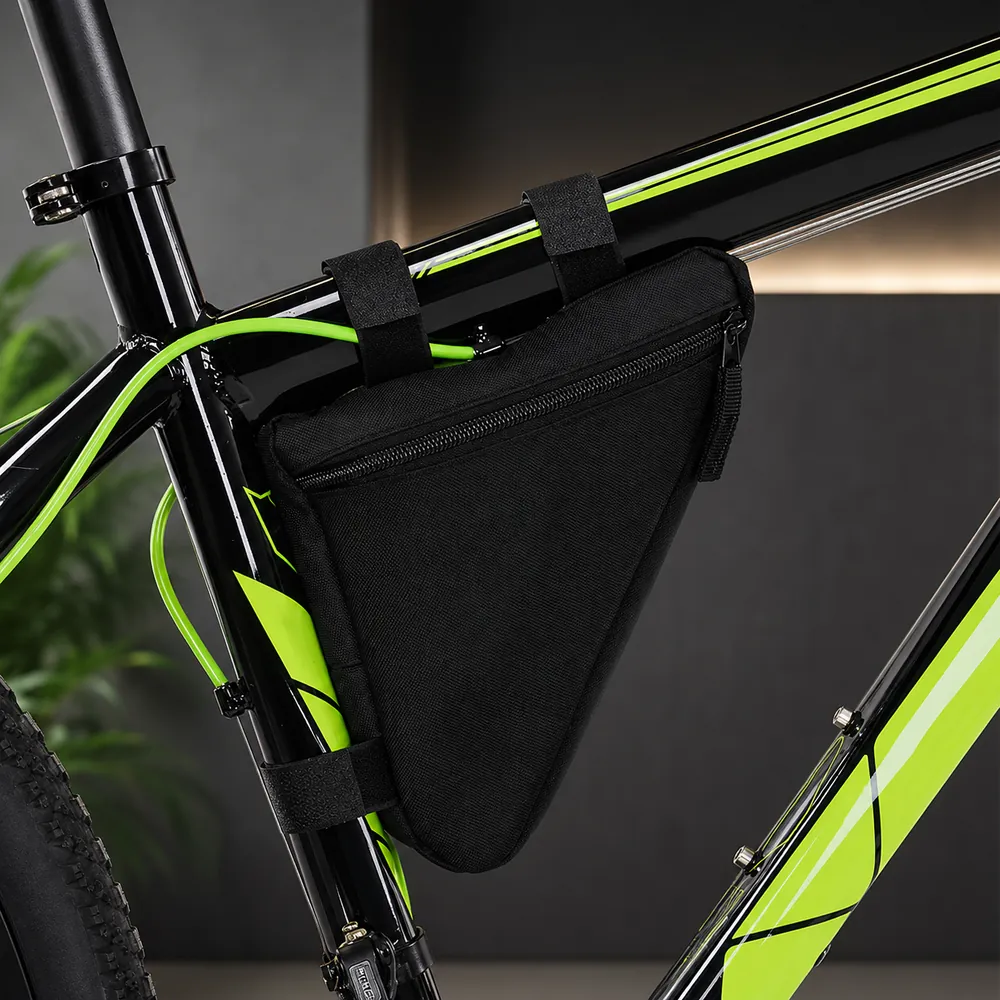
The fix starts with the part of the bike that is already empty. The open triangle between your top tube, down tube and seat tube is dead space you own: low, dead centre, and it barely changes the handling when you fill it. The Ridgeline Trail frame bag straps into it with three wide hook-and-loop straps — two on the top tube, one on the down tube — and takes the ride-essentials list off you entirely: spare tube, multitool, mini pump, snacks, phone, gloves and keys. Buyers describe the load as "plenty of room for a tube, multitool and snacks."
Shape matters here too. A compact triangle bag sits in the top front corner rather than dropping deep into the frame, which is why it usually clears a bottle in the down-tube cage — the point of the half frame bag shape. Look at your own triangle with that in mind and you will see what stays free below it. To fill the whole opening instead, the full frame bag page explains what that trades away.
The Ridgeline Trail is $29.95 (was $39.95) in black, black/red and black/blue. If you also want a phone you can read without stopping, the Ridgeline Pilot is a hard-shell waterproof top tube bag with a touchscreen window at $24.95, and the Complete Kit pairs the two for $44.95 — $9.95 less than buying them separately. The range is rated 4.7 out of 5 across 57 verified buyers on the reviews page.
Free shipping · arrives in 6 to 10 business days · 30-day money-back guarantee · secure Stripe checkout. Riding a mountain bike? See the MTB frame bag page.
Carrying a bike lock: FAQ
Where is the best place to carry a bike lock?
Wherever it cannot move and cannot reach a moving part. That usually means low and tight against a frame tube in a mount made for the lock. A lock that can swing on a strap is the one that rattles, marks paint and shifts its weight under you when the bike leans.
Can you put a bike lock in a bike frame bag?
The Ridgeline Trail is built around the ride-essentials list — spare tube, multitool, mini pump, snacks, phone, gloves and keys — and that is what it is sized for. Plan a lock as its own item with its own mount. Keeping the two apart is also what stops a hard lock body knocking against your tools on every bump.
Will carrying a bike lock scratch my frame?
It can, and grit is what does it rather than the lock. Road dust works into the gap between any hard object and your paint, then the two grind together every time the bike moves. Put something soft between metal and frame, and check under it now and then.
Is it safe to carry a bike lock on your back or on a belt?
We do not recommend it as your default. A hard, dense object clipped to your body moves when you move instead of moving with the bike, and it sits high above your center of gravity. If you do carry one this way, carry it inside a pack that closes rather than clipped to a waistband.
Why does my bike lock rattle even when it is strapped down?
Because it is one dense object with nothing packed around it, so any slack at all becomes a knock. Tighten until the lock cannot be turned by hand, then lift the bike a few inches and let it drop onto its tyres. If you hear a tap, the fix is tension rather than padding.

Marcus Reed · Gear Editor at Ridgeline
Marcus has ridden and tested cycling gear for over a decade across road, gravel and bikepacking. At Ridgeline he pressure-tests every bag on real rides before it goes live — checking fit, weight, weather resistance and how it behaves on rough ground.
Next: build the kit with what to pack in a frame bag, fit it with the step-by-step install, measure up with the sizing guide, or browse the Ridgeline guides.