· Marcus Reed
Bike Frame Bag Sizing Guide: How to Measure Your Main Triangle
Ordering a frame bag that doesn't fit is the most common — and most avoidable — mistake in this whole category. The good news: your bike's main triangle is easy to measure with a tape measure and five minutes. This guide walks you through it, tells you what fits inside a compact triangle bag, and shows you how to keep your water bottle cages usable.
What is the "main triangle" on a bike?
Stand your bike up and look at the middle of the frame. The three tubes that form that open triangle are the ones that matter for sizing. The top tube is the mostly horizontal bar between your handlebars and your saddle. The down tube is the thick diagonal that runs from the front (the head tube, near your handlebars) down to the crankset where your pedals attach. The seat tube is the vertical one your seatpost slides into. The empty area those three enclose is your usable frame-bag space.
The size and shape of that triangle changes a lot from bike to bike. A large gravel frame has a big, roomy triangle. A small road frame, a step-through commuter, or a full-suspension mountain bike with a shock in the way can have a cramped, oddly shaped triangle with very little clear space. That's exactly why measuring beats guessing — and why a compact bag that only needs a corner of the triangle fits far more bikes than a big full-frame bag that has to match the whole shape.
How to measure your main triangle in three steps
You don't need special tools — a soft sewing tape measure or even a piece of string you lay against a ruler afterward will do. Here's the sequence:
| Step | What to measure | Why it matters |
|---|---|---|
| 1. Top tube run | Clear length along the underside of the top tube, from the head tube to the seat tube. | Sets how long the bag's top edge can be, and where the top straps grab. |
| 2. Down tube run | Clear length along the top of the down tube, from the head tube down toward the crank. | Sets the front/lower reach of the bag and where the down-tube strap grabs. |
| 3. Vertical opening | The gap between the top tube and the down tube at the front, near the head tube. | Tells you how deep the bag can be before it fouls your bottle cage or knees. |
A few practical notes that save you grief:
- Measure the open space, not center-to-center. Frame geometry is often quoted tube-center to tube-center, but a bag lives in the air between the tubes. Measure the clear gap you can actually fill.
- Account for whatever's already in the triangle. Bottle cages, a shock, a rear-shock reservoir, or cables all steal usable space. Measure with them installed, because that's how you'll ride.
- Find your shortest strap zone. A compact bag mounts with velcro, so you need a short, clear stretch of tube — free of cable ports and clamps — for each strap. If your top tube is crowded with dropper or brake cables, note where the clear gaps are.
Write the three numbers on your phone before you order anything. If you're deciding between a compact bag and a bigger one, these numbers are also the difference between a half-frame bag that fits and one that hangs off the frame.
Why the Trail is sized by what fits, not by liters
A liter figure tells you nothing about your bike. A tidy "3.2 L" on a spec sheet will not tell you whether your pump slides in, whether the zip closes over a packed tube, or whether the bag clears your knee on a standing climb. The Trail is described the way you actually load it: by the kit that goes in and comes back out on a real ride.
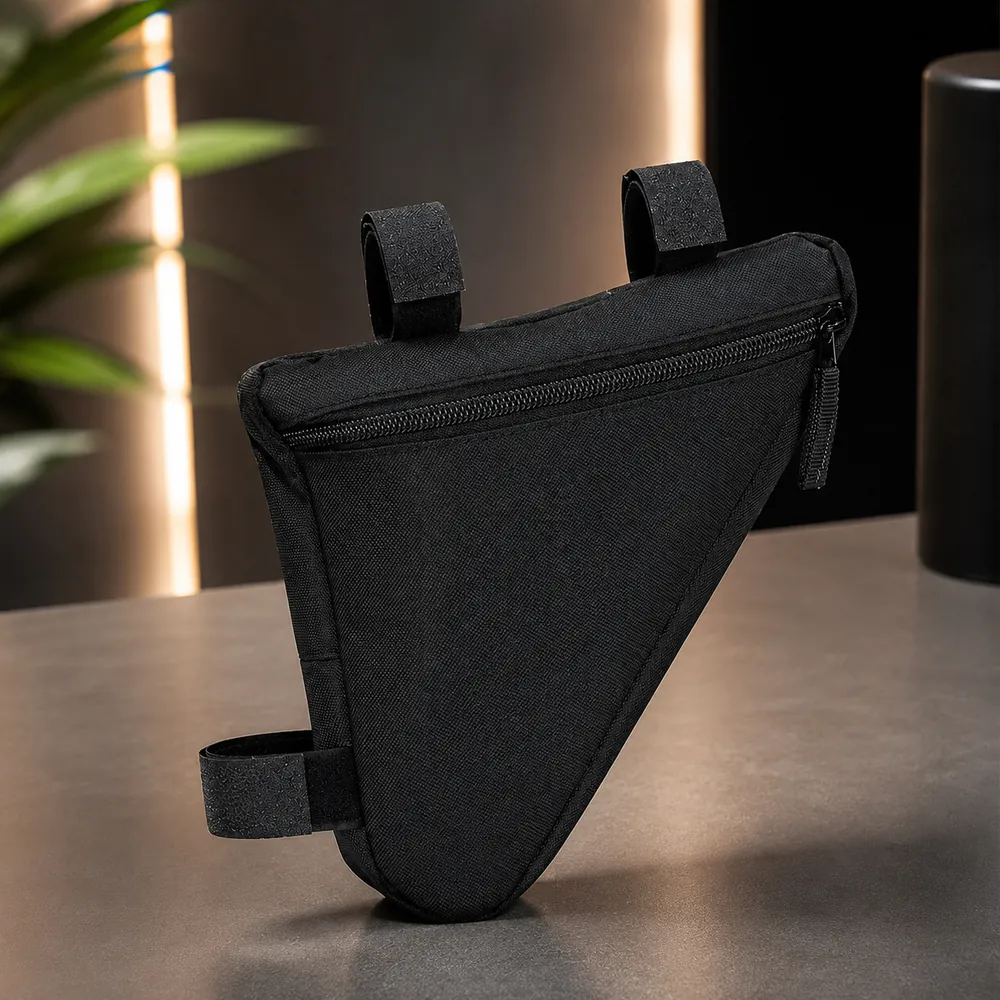
Going by verified buyer feedback, the Ridgeline Trail comfortably holds a spare tube, a multitool, a mini-pump, snacks, your phone, gloves and keys — the real kit you reach for on a normal ride. One verified buyer summed it up plainly:
"As described, quality is good. Fast shipping, plenty of room for a tube, multitool and snacks." — verified Ridgeline Trail buyer
That "fits X, Y and Z" description is more useful than a liter rating anyway, because it maps onto the pile of kit on your workbench. Packing expedition volume as well, with a sleeping layer, days of food and a water bladder inside the frame? Read our full frame bag guide, then build the setup around the Trail rather than instead of it.
What actually fits in a compact triangle bag
Here's the breakdown of what goes in, so you order the right tool the first time:
| Item | Fits a compact triangle bag? |
|---|---|
| Spare inner tube | Yes |
| Multitool / tire levers | Yes |
| Mini-pump or CO2 | Yes (most mini-pumps) |
| Phone, keys, cards | Yes |
| Snacks / energy gels | Yes |
| Light gloves / buff | Yes |
| Rain jacket, packable shell | Yes on most triangles, snug on the smallest |
| Sleeping layer, tent, days of food | Add the Wedge and Roll for a full setup |
The Trail secures with velcro straps — two on the top tube, one on the down tube — and it's built from lightweight Oxford/nylon fabric, so it fits road, MTB and gravel bikes without demanding a specific triangle shape. That's the whole advantage of a compact design: it only needs a short clear run of tube for its straps, not a perfectly matched triangle. If you ride in the rain and your priority is keeping a phone dry, pair it with our hard-shell Pilot top tube bag, or read the waterproof frame bag guide.
Bottle-cage clearance: the measurement people forget
This is the step most buyers skip, and then they're annoyed the bag "took" their bottle. The truth is simpler: bag size and bottle access trade off directly. The more of the triangle a bag fills, the more likely it is to sit over your bottle cage mounts.
A compact triangle bag lives in the top front corner of the triangle, high up near where the top tube meets the head tube. Because it doesn't drop deep into the frame, it usually clears the bottle in your down-tube cage — you can still grab and replace your bottle mid-ride. A full-frame bag, by design, fills the whole triangle and almost always blocks the in-triangle cages, pushing you toward a hydration bladder or fork-mounted bottles.
The clearance measurement takes a minute: install your bottle cages and a full bottle, then measure the vertical gap from the top of that bottle up to the underside of your top tube. That gap is the maximum depth a bag can occupy without fouling the bottle. If you run two bottles inside the triangle, you'll have less room and should lean toward the most compact option. Our triangle bike bag overview covers how different mounting positions interact with cages.
Matching bag type to your triangle and your rides
- Small, step-through, or full-suspension frames: go compact. A Trail-style bag fits the limited clear space and doesn't need a matched triangle shape.
- Commuters and daily riders: a compact bag keeps your bottle cages free for the ride to work while carrying your tube, tools and phone.
- Gravel and MTB day riders: a snug compact bag that won't rattle on rough ground — see our MTB frame bag guide for fit-by-discipline notes.
- Long-day and light-touring riders: a half-frame bag is the sensible middle if your triangle has the room.
- Multi-day, self-supported bikepackers: a bikepacking frame bag or true full-frame setup, measured precisely to your triangle.
- Road riders chasing simplicity: our road bike frame bag guide covers keeping weight low without cluttering a tight road triangle.
Why load position — not just size — matters
Sizing isn't only about cramming in gear — it's about where that gear sits. Put your tube, tools and pump in a backpack and you carry that weight high on your shoulders, sweating against your spine and shifting your balance every time you stand to climb. Move the same load into the frame triangle and it disappears: low, central, out of the wind and off your body. It's one of the few genuinely free upgrades in cycling — better handling just from where the weight lives. A verified buyer noted exactly this stability on rough ground:
"Excellent quality! Sits snug in the frame and doesn't rattle on rough ground." — verified Ridgeline Trail buyer
You don't need a big bag to get this benefit. A correctly sized compact bag delivers the same low-and-centered advantage for the gear you actually carry. You only step up in size when the volume demands it.
How many riders this actually matters to
Getting frame-bag sizing right isn't a niche concern — cycling in the US is huge, and so is the number of riders looking for a smarter place to stash a tube and a phone.
Americans ride a bicycle each year
— Outdoor Industry Association, 2023
US bike sales hit record highs during the 2020 cycling boom
— NPD Group, 2021
E-bikes are among the fastest-growing US cycling categories, outselling electric cars in unit sales
— LEVA, 2023
More riders on more kinds of bikes means more triangle shapes and sizes — which is exactly why measuring first, rather than trusting a stock photo, pays off. E-bikes in particular often have batteries or motors that eat into the triangle, so the "just eyeball it" approach fails more often than it used to. Five minutes with a tape measure beats a return.
A quick pre-order checklist
- Measured your clear top tube run, down tube run, and vertical opening.
- Checked bottle-cage clearance with a full bottle installed.
- Found clear, cable-free strap zones on your top tube and down tube.
- Matched bag type to your longest realistic ride, not your dream trip.
- Confirmed the bag is about capacity ("fits X, Y, Z") rather than a suspiciously precise liter figure.
If all five check out, you're ready to order the right bag the first time. The compact Ridgeline Trail is $29.95 (was $39.95), ships free, and is backed by a 30-day money-back guarantee — so even if you got a measurement wrong, the risk is on us, not you. Want both the frame bag and a dry phone window? The Complete Kit bundle pairs the Trail with the Pilot.
Free worldwide shipping · 30-day money-back guarantee · secure Stripe checkout

Marcus Reed · Gear Editor at Ridgeline
Marcus writes Ridgeline's guides to frame bags, bikepacking setups and carrying gear on the bike.
Still deciding on a bag type? Compare the half-frame bag and full frame bag guides, or read what verified customers report about the fit.