Full Frame Bag: What It Is, and How to Pick the Right One
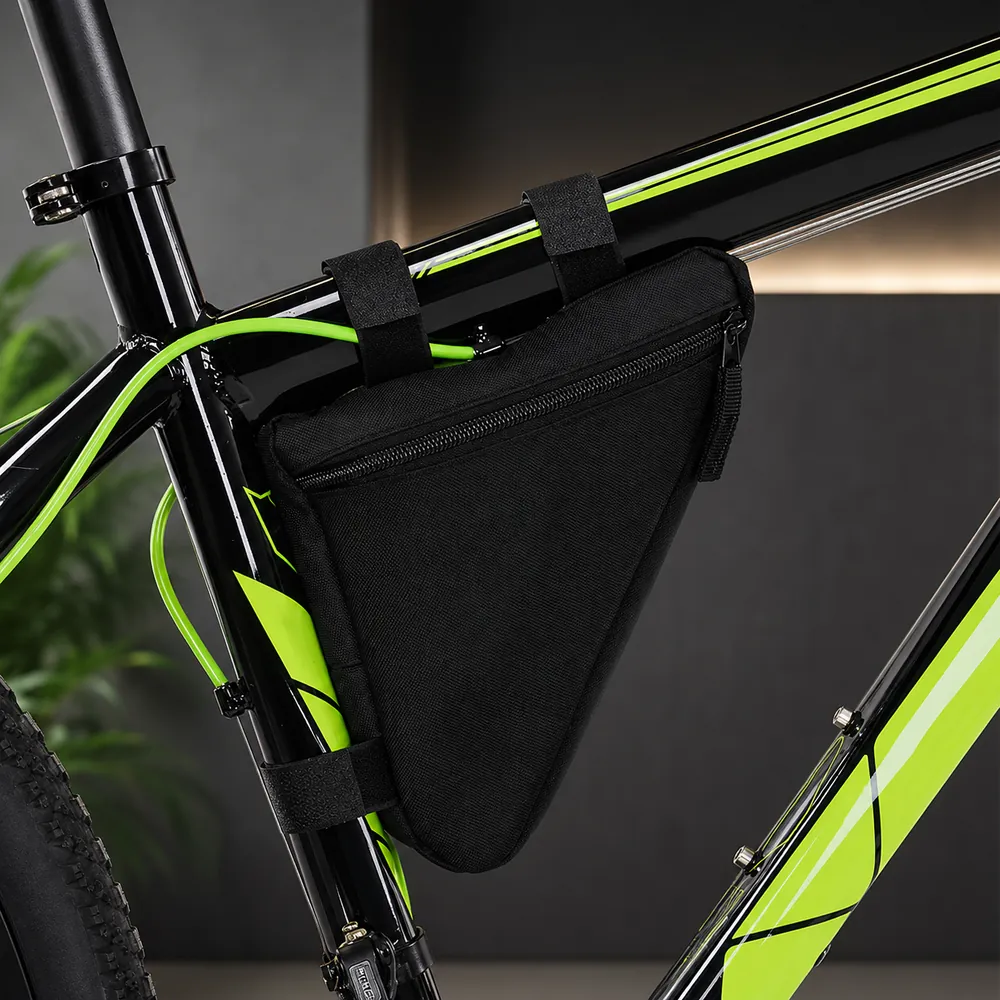
There's a lot of loose language around "full frame bag," "half-frame bag" and "frame bag." They are not the same thing, and buying the wrong cut is a common, avoidable mistake. This guide explains each one in plain terms, tells you which rider each one suits, and shows you exactly where the Ridgeline Trail fits and what it carries.

Marcus Reed · Gear Editor at Ridgeline
Marcus writes Ridgeline's guides to frame bags, bikepacking setups and carrying gear on the bike.
Pick your bag
🚨 Only a few left in stock
Free shipping · 30-day money-back guarantee · Secure checkout
What a full frame bag actually means
Picture the triangle in the middle of your bike. A full frame bag is cut to fill that entire space, wrapping around all three tubes and using every square inch of the opening. That's why bikepackers reach for one on multi-day routes: it turns dead air into serious storage for a sleeping bag layer, food, a water bladder, tools and spares — all carried low in the frame rather than on your back.
But a full-frame bag is a commitment. Because it's sized to one specific triangle, fit is fussy — a bag cut for a large gravel frame won't sit right on a small road frame. It typically eats your in-triangle bottle mounts, so you're pushed toward a bladder or fork-mounted bottles. And it's more bag, more weight and more cost than a lot of riders will ever use. That's the picture, not the marketing one.
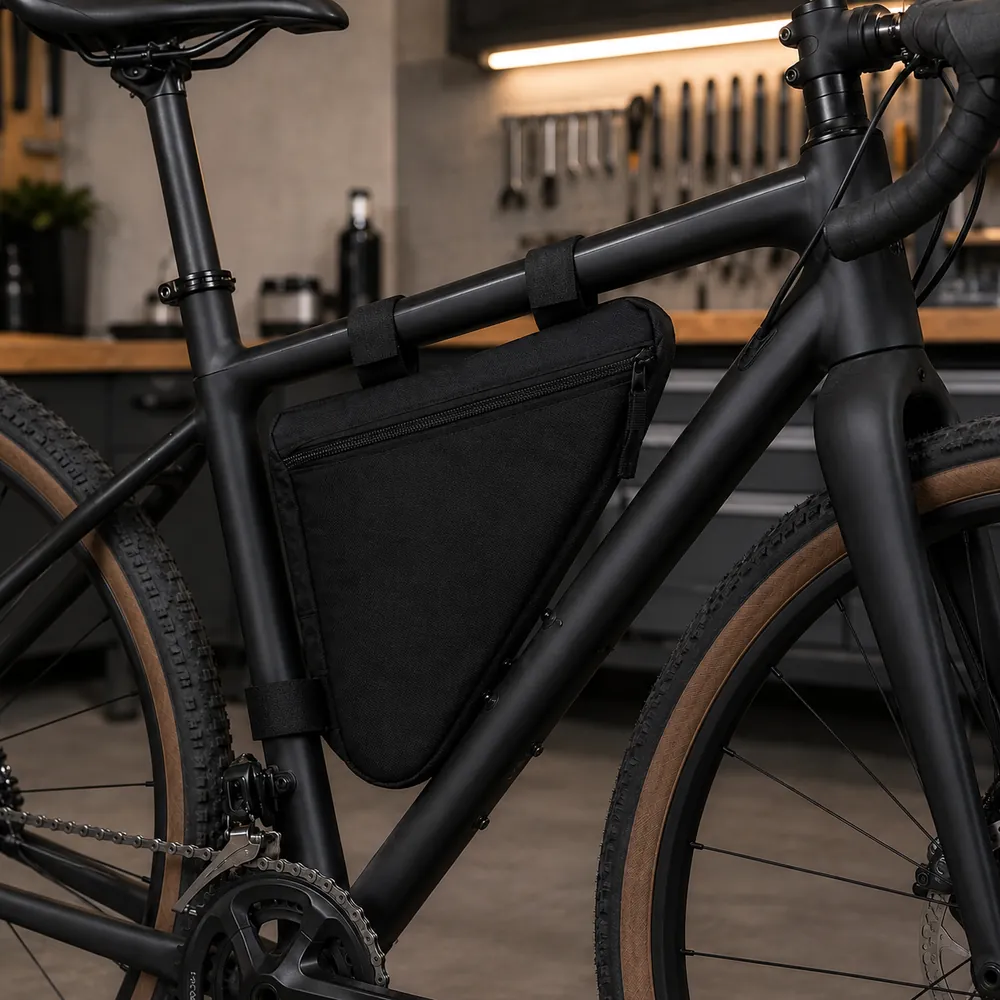
Full frame bag vs half-frame bag vs compact triangle bag
The three types sit on a spectrum from "carry everything" to "carry what you use." Here's how they compare on the things that actually matter when you're standing over your bike deciding what to buy.
| Feature | Full frame bag | Half-frame bag | Ridgeline Trail (compact triangle bag) |
|---|---|---|---|
| Space it uses | Entire main triangle | Upper half of triangle | Top corner of triangle |
| Carrying volume | Highest | Medium | Essentials only |
| Bottle cage access | Usually blocked | Often keeps one cage | Cages stay free |
| Fit across bikes | Frame-specific, fussy | Moderate | Fits almost any frame |
| Best for | Multi-day bikepacking | Long day rides, light tours | Daily rides, commutes, gravel loops |
| Added weight | Most | Some | Least |
Notice the pattern: you gain volume as you move left, and you gain simplicity, fit and convenience as you move right. There's no "best" type in the abstract — only the best type for the way you actually ride. Most people overestimate how much they need to carry and end up hauling empty space. That's a real cost: bulk near your knees, wind drag, and a bag that's fiddlier to fit.
Where the load sits — and why it matters
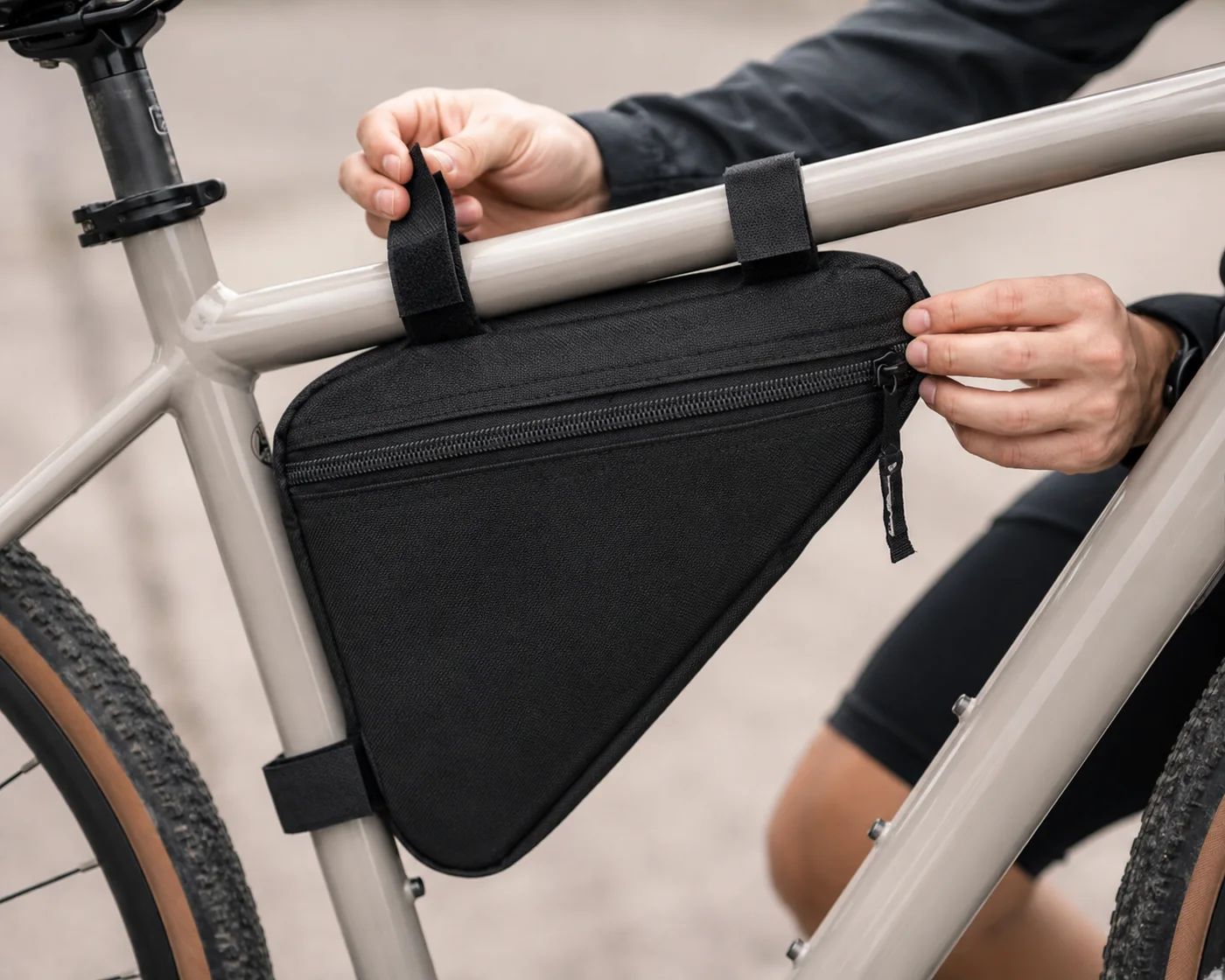
This is the quiet reason frame bags of every size feel good on the road. Put the same tube, multitool and pump in a backpack and you carry that weight high on your shoulders, sweating against your spine and shifting your balance every time you stand to climb. Move it into the frame triangle and it disappears — low, central, out of the wind and off your body. It's one of the few genuinely free upgrades in cycling: better handling and more comfort just from where the load lives.
The point is that you don't need a full-frame bag to get this benefit. A compact triangle bag delivers the same low-and-centered advantage for the gear you actually carry on a normal ride. You only step up to a bigger bag when the volume demands it — not to unlock better handling.
What the Ridgeline Trail carries inside your frame
The Trail is not a full frame bag: it is a compact triangle bag built for the rides you actually do. It mounts inside the frame at the top tube corner and holds the things you reach for on a real ride: a spare tube, a multitool, a mini-pump, snacks, your phone and keys. It leaves your bottle cages free, fits road, MTB and gravel bikes, and stays out of your way.
Here's the plain-English test. A week of self-supported bikepacking, with a sleeping layer, days of food and a water bladder to carry inside the triangle, is the one case that calls for a real full frame bag, sized to one specific frame and fitted once. The Trail is too small for that load.
Every other ride belongs to the Trail. Commute, weekend gravel loops, day rides, or simply getting your tube and tools off your back and into the frame where they belong: this is the bag, and a full frame bag would be volume you'd fight to fit and never fill. One of our verified buyers put the in-frame fit well:
"Excellent quality! Sits snug in the frame and doesn't rattle on rough ground." — verified Ridgeline Trail buyer
The Trail is built from lightweight Oxford/nylon fabric and secures with three velcro straps (two on the top tube, one lower on the frame). It comes in black, black/red and black/blue. It's $29.95 (was $39.95), ships free, and is backed by a 30-day money-back guarantee — so if it turns out you needed more bag, the risk is on us, not you.
Who each type of bag is for
- Commuters and daily riders: a compact triangle bag like the Trail. You carry a tube, tools and your phone, and you want your bottle cages free for the ride to work.
- Gravel and MTB day riders: a compact bag that sits snug and doesn't rattle on rough ground — see our MTB frame bag guide and road bike frame bag guide for fit notes by discipline.
- Long-day and light-touring riders: a half-frame bag is the sensible middle — more volume, but it still leaves you a bottle cage.
- Multi-day, self-supported bikepackers: a true full frame bag or a dedicated bikepacking frame bag setup, sized to your specific triangle.
- Riders in wet climates: if weather is your main worry, prioritize a waterproof bike frame bag or pair the Trail with our hard-shell Pilot top tube bag for a phone that stays dry.
Not sure which triangle size or type suits your frame? Our frame bag sizing guide walks through measuring your triangle so you don't order a bag that won't fit — a mistake that's much easier to make with full and half-frame bags than with a compact one.
Why frame bags are worth it for so many US riders
Cycling in the US isn't a niche — and neither is the need to carry a few essentials on the bike instead of on your back.
Americans ride a bicycle each year
— Outdoor Industry Association, 2023
US bike sales hit record highs during the 2020 cycling boom
— NPD Group, 2021
E-bikes are among the fastest-growing US cycling categories, outselling electric cars in unit sales
— LEVA, 2023
The takeaway from all that growth: more riders, on more kinds of bikes, all facing the same simple question, which is where the tube, pump and phone go. For the large majority the answer is a frame bag that carries the essentials low in the triangle and gets out of the way, and that is the Trail. Loading up for multi-day routes instead? Read our bikepacking frame bag guide and the sizing guide before committing.
The bottom line
A full frame bag puts your load where it handles best: low, centered, inside the triangle. But it adds volume, weight and a fussier fit, and it costs you your in-triangle bottle mounts. For daily rides, commutes and weekend loops the Ridgeline Trail gives you the same low-and-centered advantage without any of that overhead, at $29.95 with free shipping and a 30-day money-back guarantee. Riding longer? Pair it with a half-frame bag setup. Start with the bag you'll use on every ride.
Free shipping to 18 countries · 30-day money-back guarantee · secure Stripe checkout
Full frame bag FAQ
What is a full frame bag?
A full frame bag fills the entire main triangle of your bike frame — from the head tube back to the seat tube, and from the top tube down to the down tube. It maximizes carrying volume for long-distance bikepacking, but it usually blocks water bottle cage mounts inside the triangle.
Is the Ridgeline Trail a full frame bag?
No. The Ridgeline Trail is a compact triangle bag. It straps into the top corner of the main triangle, with two velcro straps on the top tube and a third lower on the frame, so the load still rides low and centered. It carries the essentials you reach for on every ride: tube, multitool, pump, snacks, phone and keys. It does not fill the triangle, so it will not take a multi-day bikepacking load, but it leaves your bottle cages free.
Do I really need a full frame bag?
Only if you carry a multi-day load inside the frame: a sleeping layer, days of food, a water bladder. For commutes, gravel loops and day rides, a compact triangle bag like the Trail ($29.95) gets your tube, tools, pump and phone off your back and low in the frame, and keeps your bottle mounts usable. A full frame bag is sized to one triangle and built for multi-day self-supported trips.
Will a full frame bag or a compact bag fit my bike?
A compact bag like the Trail fits almost any frame — road, MTB or gravel — because it only needs a short run of top tube, plus one tube lower down, for its velcro straps. Full-frame bags are sized to a specific triangle shape, so fit is far fussier. Our sizing guide gives the measurements for either type.
Prefer to read verified buyer feedback first? See our customer reviews, or explore the Complete Kit bundle that pairs the Trail with the Pilot phone bag.